
- Home
- Lawrence Block
Ariel Page 19
Ariel Read online
Page 19
“By their mother? I’m sorry, I didn’t catch her name.”
“Grace Molineaux. What it was like is Lizzie Borden. Did she do it or was it a prowler? Now I myself wasn’t around at the time, David. I’m not quite that ancient. I’m going back to a childhood recollection of conversations about an event that took place before I was born. I believe everybody thought she did it but had no proof. And she came from good family, good old French Huguenot stock, and people sympathized with her over losing her husband. So she was never charged with the murders.”
“And she went on living alone like Lizzie Borden? While children taunted her with rhymes?”
“If she did, it wasn’t for long. She killed herself. They found her hanging from a rope. Or did she take the gas pipe? It’s one or the other, it seems to me. Either way she killed herself.”
“Which amounted to an admission of guilt for the murder of her children, I gather.”
“Do you suppose it did? You could also take it that she was despondent. Had nothing to live for what with her husband and kids all gone. They argued it both ways but it seems to me I grew up more or less taking it for granted that she killed those babies.”
“And it happened in our house?”
“Might have.” She shrugged majestically. “I knew which house it was when I was a child,” she said. “It was pointed out to me. I recall that it was a big old red-brick house and it seems to me it was on that block and it might have been the same house you’re living in today. But they might have pointed out the wrong house to me or my memory might be at fault or any of a hundred other things. You could find out if you wanted.”
“How?”
“Check the deed registry in the county clerk’s office. Nate Howard’ll help you out if you mention my name. He’s an old friend. Wait a moment, that might not help. I think Molineaux might have been her maiden name and the house would have been registered to the sea captain. Or maybe not. Now if you were to go over to the Post-Courier they’ll have back issues into the last century, and they could probably help you.”
“I don’t think it’s worth the trouble, do you?”
She shook her head. “No,” she said. “I frankly don’t. But if Grace Molineaux lived and died in your house, well, it kind of adds up, don’t it? A woman grieving for a child is going to be sensitive to the vibrations of a woman who lost four children under the same roof. Unless you don’t believe any of that crap in the first place.”
“All of a sudden I’m having trouble figuring out what I believe and what I don’t believe.”
“Well, congratulations! I think somebody said that’s the beginning of wisdom.”
“You mean there’s hope for me, Etta?”
“Hope for us all, or so I’m told. Want some advice from a fat old lady? Your Roberta’s having a bad time. That’s perfectly natural. Be surprising if she weren’t, all in all. You go home and tell her the house is listed for sale. That way she’ll think you’re taking some steps to solve the problem. It’ll be that much of a load off her mind. Meantime I won’t list the house at all. Or I’ve a better idea. I’ll list it, but I’ll put it on the card at ninety-five. Nothing against your house, it’s a fine property, but the fool hasn’t been born yet who’s going to pay ninety-five thousand for it or even ask to go through it at that figure. And if he turns up, well, maybe you wouldn’t mind making that kind of a profit on the transaction, or would you?”
“Not at all.”
“Fine. So the house’ll be listed, and if Roberta ever happens to check you won’t turn out a liar. But it won’t sell and you won’t have to move and as soon as she works things out in her mind and comes to terms with her life, then you can take the house back off the market. How does that sound?”
“It sounds good, Etta.”
“Just because a house is haunted is no reason to move out of it,” she said. “The hell, it’s less lonely that way.”
Later that day he felt vaguely dissatisfied and wondered why. It seemed illogical that he should be bothered at deceiving Roberta; the deception was harmless enough, and was designed to help put her mind at ease.
Perhaps it was the story Etta Jellin had told. It was preposterous that such a solid earthy woman could actually believe in haunted houses, and her belief became all the more convincing for her general air of no-nonsense earthiness.
Grace Molineaux took a pillow
And planted her kids beneath a willow.
Not terribly good, he thought. Willow was all too obviously there just to rhyme with pillow. The bit about Lizzie Borden might also be doggerel, but at least it was good doggerel.
Grace took a pillow and gave a shove
And smothered her kids with mother’s love
That was better. A shame he couldn’t share it with Roberta, but if one thing was certain it was that he could not say Word One to Roberta about Grace Molineaux and her claim to infamy.
Not that he felt there was more than a chance in a hundred that the woman had actually lived in their house. Of course it was possible, just as it was possible that Grace herself was the subject of the portrait Ariel seemed to be so fond of. Under normal circumstances that was the sort of thing Roberta would have enjoyed believing.
But circumstances had not been normal for quite some time now.
No, this was something he couldn’t possibly risk mentioning to Roberta.
EIGHTEEN
When Ariel got out of bed that morning her night table was centered under the portrait of the woman with the rose. Its top was empty except for the jar lid. The candle stub had burned down to less than half an inch. A burnt match lay in a pool of congealed wax at the side of the candle.
She moved quickly, putting the candle away, returning her table to its usual position, replacing her clock and lamp on top of it. Then, hesitantly, she looked up at the portrait.
Evidently she had awakened in the middle of the night to go through the candle ritual again. But she couldn’t remember any of it. As far as she could recall, she hadn’t even dreamed during the night. The last thing she recalled was lying in bed on the verge of sleep.
Maybe she had gotten up in the middle of the night to go to the bathroom. Sometimes that happened and she’d go and come back and be half asleep, barely able to remember it the next day.
But this was different, wasn’t it? Whatever woke her, whatever got her out of bed, she’d evidently gone through a whole ritual with the candle, moving furniture and lighting a match and doing God-knew-what while the candle burned. She looked at the portrait again, trying to learn something from the woman’s compelling gaze, but it didn’t help. Her memory was blank and it frightened her.
Was that all she had done? Just light a candle and go through some mental hocus-pocus number?
Or had she left her room?
She dressed and left it now, walking directly to the bathroom, hurrying past the closed door of Caleb’s room. She washed up, brushed her teeth, used the toilet. In the hallway, she cocked her head and listened. David and Roberta were both downstairs.
She walked to Caleb’s door, stood outside it for a moment. Her hand settled on the doorknob, hesitated. She turned the knob, drew a breath, opened the door.
The room was untouched. Everything was as it had been when Roberta last straightened it. Caleb’s fish mobile remained in place over the crib.
Relief. Whatever weirdness she’d been a part of last night, at least she hadn’t done a number on Caleb’s room.
She closed Caleb’s door and went downstairs for her breakfast.
While Jeff Channing had known Etta Jellin for years, it never occurred to him to turn to the realtor for information about previous occupants of the red-brick house on Legare Street. Instead he did what his legal training had taught him to do, searching the house’s title. He’d done this sort of thing any number of times in connection with real estate transactions, and there was no particular difficulty now in tracing the ownership of the house down through the years since it was built
in 1822 by a Colonel Joseph Warren Clay.
The house had changed hands half a dozen times during the nineteenth century. A man named James Petersmith had bought it in 1903. His children had sold shortly after the 1929 stock market crash, and since then the house had never remained in the hands of a single owner for longer than seven years. Several owners had bought and sold the place within periods of less than a year.
A curious history, he thought. Americans were a mobile lot, certainly, especially since World War Two. He recalled reading somewhere that twenty percent of the nation’s families pulled up roots and moved every year. But homes in Old Charleston didn’t tend to turn over quickly. The sort of people who were attracted to them tended to stay put for a while.
Maybe there was something about the house, something vaguely disquieting that made its occupants sufficiently uncomfortable to sell and move on. The Traphagens, who had sold to the Jardells, had been transferred to another location, and no doubt other residents had had similarly sound reasons for moving. But it seemed a fair assumption that at least a few of the house’s recent owners had been made uneasy by the night sounds and had shrunk from the damp. Perhaps they’d seen things in the corners of the bedrooms too. Perhaps their noses had wrinkled at the smell of gas when the stove’s pilot lights had refused to stay lit. After a while people could weary of rationalizing the peculiar and just get out … unless, like himself, a person was concerned about one of them and was drawn in, out of curiosity and concern, to probe further, regardless of realistic skepticism … in spite of it …
Odd, too, that no one had even gotten around to replacing the old gas range. Odd, for that matter, that so many owners had made so few changes in the old house.
Odder still that the portrait had lain unnoticed for years until Ariel came on it. You would have thought some previous owner would have cleaned out the attic.
By the time he left the Deeds Registry, Jeff had covered a sheet of paper with names running all the way back from Traphagen, Carl and Julia, to Clay, Colonel Joseph Warren. He scanned the list, unsure that it represented anything beyond busywork. The subject of the portrait in Ariel’s room might be on the list, and if so hers was very likely one of the first six or eight names on it. But it seemed even more likely to him that some recent tenant had picked up the portrait at an auction or garage sale, then stowed it in the attic and forgot it at moving time. The painting needn’t have anything to do with Bobbie’s house; indeed the woman it depicted might well never have been within five hundred miles of Charleston in her life.
Fool’s business, he thought. And it wasn’t as if he didn’t have anything better to do. He’d been letting his work slide shamefully lately, staying away from the office for long stretches every day and finding himself incapable of concentrating during those rare hours that he did spend at his desk. The informal title search he’d just conducted was the first genuine legal work he’d done in far too long.
It was, no question, getting to him and he didn’t know just what to do about it. His inability to work was just a symptom, and not the worst of the lot. His mind was acting strangely, hurling uncomfortable thoughts at him, leaving him anxious and jumpy inside however calm the exterior he managed to present to the world. His perceptions were askew, his judgment unreliable.
He kept a lid on this most of the time. When Bobbie had shown him the portrait, he’d been strong and logical and reassuring, the apostle of pure reason.
Yet he’d looked at the portrait and had seen, instantly. Ariel’s face. Ariel as an adult, strong and seductive, pale face shining and damned eyes burning hypnotically as they had burned when they had held and looked into his. That was what he had seen—but he had given no sign, and a later glance told him, all reasonably, that the portrait was merely a portrait, the woman in it merely a long-dead flower of the south.
Sometimes it seemed obvious to him that the only answer lay in breaking things off with Bobbie once and for all. The hours they spent in interchangeable motel rooms, for all the frenzy and heightened tension, were increasingly unsatisfying, leaving him time and again with a feeling not unlike a hangover, dry of mouth, short of breath, determined never to touch the stuff again. That he elected to continue the affair sometimes seemed to him the clearest evidence of all that he was indeed losing his grip on things, that he was truly losing his mind.
And yet something inside him kept insisting that Bobbie was the core of his life, his destiny—she was the mother of his dead child … they’d shared life and death, after all— that the hours he spent away from her were unbearably flat and lifeless. Just the other night he’d been sitting in the basement recreation room with Elaine and the girls, watching something unmemorable on the tube, glancing from time to time at the wet bar and the knotty pine walls and the recessed lighting, then at his wife and daughters, then once more at the oversize color television set. The good life in the suburbs, he had thought, and all of it hollow, pointless, and he found himself yearning to be away from all of this, away from it and from them forever, alone somewhere on an island or in a city or off in the middle of the desert with Bobbie—her pull was that strong, however much she upset him.
There was a time, he thought now, when that might have worked. When she was pregnant with his child, that would have been the moment for them to turn their backs on everything and just go. But instead it was the moment that had just gone, and he had stayed with Elaine while she had stayed with David, and Caleb was born and died and—
Well, fool’s business, he told himself, was better than no business at all. He left the Deeds Registry, strode on foot to his office and past it, and headed for the newspaper offices.
Erskine was waiting for her when school let out. “Well, we’re on our way,” he said. “Got busfare?”
“Oh.”
“Nice day for an expedition, isn’t it? Sunny, not too cold out.”
“Maybe we should forget it.”
He looked at her.
“Well, I haven’t even seen him around the past few days,” she said. “Maybe Roberta just had to see him for some reason or other, and then we happened to see him a few times out of coincidence.”
“Some coincidence.”
“It’s possible.”
“Why would she be seeing some lawyer, anyway?”
“Maybe to get a divorce.”
“From David?”
“Well, who else is she married to, birdbrain? Of course from David. She’d be glad to get a divorce from me but you can’t divorce children. It doesn’t work that way. The only way she can get rid of me …”
“What were you going to say?”
“I was going to say the only way she’ll get rid of me is by killing me, but I don’t want to say it too loud. I wouldn’t want to give her any ideas.”
They walked as they talked, heading automatically for the bus stop on Meeting Street. Erskine pointed out that Channing had been at the funeral, that he had been cropping up in their lives too frequently for his connection to be merely professional.
“Oh, I know,” Ariel said. “I just don’t know if I feel like going all the way out there, but it’s all right. I’m going, aren’t I?”
“It’s just a bus ride and a walk.”
“And a bus ride back.”
“Right. Maybe we’ll see his kids. Greta and Debbie.”
“That’ll be a thrill. Which was the one you talked to?”
“Greta. She’s the older one.”
“Right, and you told her you were Graham. You can show her your spleen.”
“You always tell me I’m gross, Jardell.”
“Well, look who taught me. Maybe she’ll be cute and you can make out with her.”
“She’s all of nine years old, remember?”
“Well, tell her you’re Graham and you can pretend she’s Veronica.”
“You must have taken a weird pill today, Jardell.”
On the bus, he said, “Speaking of Veronica, she wasn’t in school today.”
&nbs
p; “So?”
“I wonder what’s wrong with her.”
“The poor little thing probably has the sniffles.”
“Maybe.”
“Of course if you want to send her a get-well card, go right ahead. What’s the big deal that she stayed home from school today?”
He shrugged. “Just that I was thinking,” he said. “That conversation we had, and then Graham got hit by a car and now Veronica stayed home from school.”
“That doesn’t make any sense.”
“I suppose not.”
She thought of a candle stub centered beneath a portrait—but that was crazy. She hadn’t done anything. She hadn’t even thought of Veronica in days.
“Graham got hit by a car,” she said.
“I know.”
“And Veronica probably has a cold or a stomach ache. Or maybe she just stayed home to go someplace with her mother.”
“Maybe.”
“Talk about me being weird today, Mr. Erskine Wold. You could make money giving weird lessons.”
Investigation is a simpler process when you know what you’re investigating. If Jeff had had the benefit of David’s conversation with Etta Jellin, he’d have been looking for material on Grace Molineaux from the start. Instead he had to spend several hours in the newspaper files, scanning endless yellowed issues of last century’s newspapers for anything he could find relating to various occupants of the brick house on Legare Street. He came on the stories of several persons who had died in the house and made copious notes on each, having no way of knowing whether or not he’d found what he was looking for.
When he hit Grace Molineaux, he knew he was home.
The story was much as Etta Jellin remembered it, with a few exceptions. Grace Duprée Molineaux’s four children, three boys and a girl ranging in age from four months to five years, all died within a three-week period in September of 1882. The youngest, a boy, was the first to go, dying in his sleep on the night of the fifth. The girl, a three-year-old, died six days later, and her eighteen-month-old brother perished the same night. The oldest boy failed to wake up on the morning of the twentieth.
 Tanner on Ice
 Hit Me
 Hit and Run
 Hope to Die
 Two For Tanner
 Tanners Virgin
 Dead Girl Blues
 One Night Stands and Lost Weekends
 A Drop of the Hard Stuff
 The Canceled Czech
 Even the Wicked
 Me Tanner, You Jane
 Quotidian Keller
 Small Town
 Tanners Tiger
 A Walk Among the Tombstones
 Tanners Twelve Swingers
 Gym Rat & the Murder Club
 Everybody Dies
 The Thief Who Couldnt Sleep
 Hit Parade
 The Devil Knows Youre Dead
 The Burglar in Short Order
 A Long Line of Dead Men
 Keller's Homecoming
 Resume Speed
 Keller's Adjustment
 Eight Million Ways to Die
 Time to Murder and Create
 Out on the Cutting Edge
 A Dance at the Slaughter House
 In the Midst of Death
 When the Sacred Ginmill Closes
 You Could Call It Murder
 Keller on the Spot
 A Ticket to the Boneyard
 A Time to Scatter Stones
 Keller's Designated Hitter
 A Stab in the Dark
 Sins of the Fathers
 The Burglar in the Closet
 Burglar Who Dropped In On Elvis
 The Burglar Who Painted Like Mondrian
 The Girl With the Long Green Heart
 The Burglar Who Counted the Spoons (Bernie Rhodenbarr)
 Burglar Who Smelled Smoke
 Rude Awakening (Kit Tolliver #2) (The Kit Tolliver Stories)
 Don't Get in the Car (Kit Tolliver #9) (The Kit Tolliver Stories)
 CH04 - The Topless Tulip Caper
 You Can Call Me Lucky (Kit Tolliver #3) (The Kit Tolliver Stories)
 CH02 - Chip Harrison Scores Again
 Strangers on a Handball Court
 Cleveland in My Dreams
 Clean Slate (Kit Tolliver #4) (The Kit Tolliver Stories)
 The Burglar Who Traded Ted Williams
 Burglar on the Prowl
 In For a Penny (A Story From the Dark Side)
 Catch and Release Paperback
 Ride A White Horse
 No Score
 Looking for David (A Matthew Scudder Story Book 7)
 Jilling (Kit Tolliver #6) (The Kit Tolliver Stories)
 Ariel
Ariel Enough Rope
 Grifter's Game
 Canceled Czech
 Unfinished Business (Kit Tolliver #12) (The Kit Tolliver Stories)
 Thirty
 The Burglar Who Thought He Was Bogart
 Make Out with Murder
 One Last Night at Grogan's (A Matthew Scudder Story Book 11)
 The Burglar on the Prowl
 Welcome to the Real World (A Story From the Dark Side)
 Keller 05 - Hit Me
 Walk Among the Tombstones: A Matthew Scudder Crime Novel
 Ronald Rabbit Is a Dirty Old Man
 The Burglar Who Studied Spinoza
 The Burglar Who Liked to Quote Kipling
 Keller in Des Moines
 Hit List
 The Dettweiler Solution
 HCC 115 - Borderline
 A Drop of the Hard Stuff: A Matthew Scudder Novel
 Step by Step
 The Girl With the Deep Blue Eyes
 If You Can't Stand the Heat (Kit Tolliver #1) (The Kit Tolliver Stories)
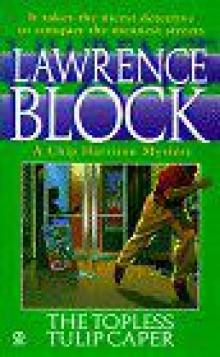 The Topless Tulip Caper
 Dolly's Trash & Treasures (A Story From the Dark Side)
 The Triumph of Evil
 Fun with Brady and Angelica (Kit Tolliver #10 (The Kit Tolliver Stories)
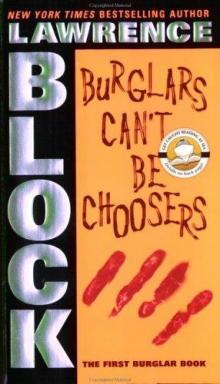 Burglars Can't Be Choosers
 Who Knows Where It Goes (A Story From the Dark Side)
 Deadly Honeymoon
 Like a Bone in the Throat (A Story From the Dark Side)
 A Chance to Get Even (A Story From the Dark Side)
 The Boy Who Disappeared Clouds
 Collecting Ackermans
 Waitress Wanted (Kit Tolliver #5) (The Kit Tolliver Stories)
 One Thousand Dollars a Word
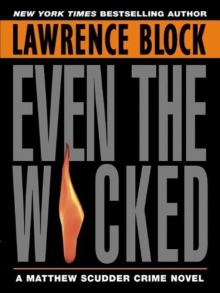 Even the Wicked: A Matthew Scudder Novel (Matthew Scudder Mysteries)
 Hit Man
 The Night and The Music
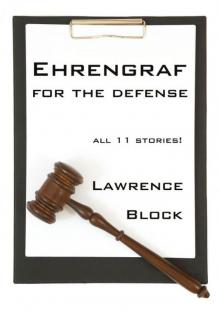 Ehrengraf for the Defense
 The Merciful Angel of Death (A Matthew Scudder Story Book 5)
 The Burglar in the Rye
 I Know How to Pick 'Em
 Getting Off hcc-69
 Three in the Side Pocket (A Story From the Dark Side)
 Let's Get Lost (A Matthew Scudder Story Book 8)
 Strange Are the Ways of Love
 MOSTLY MURDER: Till Death: a mystery anthology
 Masters of Noir: Volume Four
 A Week as Andrea Benstock
 Scenarios (A Stoiry From the Dark Side)
 The Sex Therapists: What They Can Do and How They Do It (John Warren Wells on Sexual Behavior Book 15)
 Like a Thief in the Night: a Bernie Rhodenbarr story
 A Diet of Treacle
 Community of Women
 Different Strokes: How I (Gulp!) Wrote, Directed, and Starred in an X-rated Movie (John Warren Wells on Sexual Behavior)
 You Don't Even Feel It (A Story From the Dark Side)
 Zeroing In (Kit Tolliver #11) (The Kit Tolliver Stories)
 The Wife-Swap Report (John Warren Wells on Sexual Behavior)
 Keller's Fedora (Kindle Single)
 Speaking of Lust
 Everybody Dies (Matthew Scudder)
 Defender of the Innocent: The Casebook of Martin Ehrengraf
 After the First Death
 Writing the Novel
 How Far - a one-act stage play
 Chip Harrison Scores Again
 The Topless Tulip Caper ch-4
 The Crime of Our Lives
 Killing Castro
 The Trouble with Eden
 Nothing Short of Highway Robbery
 Sin Hellcat
 Getting Off: A Novel of Sex & Violence (Hard Case Crime)
 Coward's Kiss
 Alive in Shape and Color
 Blow for Freedom
 The New Sexual Underground: Crossing the Last Boundaries (John Warren Wells on Sexual Behavior Book 10)
 April North
 Lucky at Cards
 One Night Stands; Lost weekends
 Sweet Little Hands (A Story From the Dark Side)
 Blood on Their Hands
 A Dance at the Slaughterhouse
 Headaches and Bad Dreams (A Story From the Dark Side)
 Keller's Therapy
 The Specialists
 Hit and Run jk-4
 Threesome
 Love at a Tender Age (John Warren Wells on Sexual Behavior)
 The Devil Knows You're Dead: A MATTHEW SCUDDER CRIME NOVEL
 Funny You Should Ask
 CH01 - No Score
 Sex and the Stewardess (John Warren Wells on Sexual Behavior)
 A Madwoman's Diary
 When This Man Dies
 Sinner Man
 Such Men Are Dangerous
 A Strange Kind of Love
 Enough of Sorrow
 69 Barrow Street
 A Moment of Wrong Thinking (Matthew Scudder Mysteries Series Book 9)
 Eight Million Ways to Die ms-5
 Warm and Willing
 Mona
Mona In Sunlight or In Shadow
 A Candle for the Bag Lady (Matthew Scudder Book 2)
 Conjugal Rites (Kit Tolliver #7) (The Kit Tolliver Stories)
 Speaking of Lust - the novella
 Gigolo Johnny Wells
 Dark City Lights
 Versatile Ladies: the bisexual option (John Warren Wells on Sexual Behavior)
 Passport to Peril
 The Taboo Breakers: Shock Troops of the Sexual Revolution (John Warren Wells on Sexual Behavior)
 Lucky at Cards hcc-28
 Campus Tramp
 3 is Not a Crowd (John Warren Wells on Sexual Behavior)
 Manhattan Noir
 The Burglar in the Library
 Doing It! - Going Beyond the Sexual Revolution (John Warren Wells on Sexual Behavior Book 13)
 So Willing
 The Burglar Who Traded Ted Williams br-6
 Candy
Candy Sex Without Strings: A Handbook for Consenting Adults (John Warren Wells on Sexual Behavior)
 The Devil Knows You're Dead: A MATTHEW SCUDDER CRIME NOVEL (Matthew Scudder Mysteries)
 Manhattan Noir 2
 The Scoreless Thai (aka Two For Tanner)